Electric vs Manual Wine Openers: An Honest Comparison
Should you buy an electric or manual wine opener?
Short answer: The choice between electric vs manual wine openers comes down to how often you open a bottle. A manual corkscrew is cheaper, never needs charging, and is what most sommeliers actually carry. An electric opener removes the effort and the broken corks, and opens a bottle in about six seconds. If you open wine a few times a year, buy a good waiter's friend. If you open it weekly, entertain, or have any grip or wrist trouble, electric earns its counter space.
Below is the long version - including the cases where we'd tell you not to buy ours.
Last updated: August 2026
The quick verdict
-
Open a bottle a few times a year - A good waiter's friend, $12–$30
-
Travel, camp, or picnic often - Manual - nothing to charge
-
Collect older wine with fragile corks - Manual, opened slowly by hand
-
Open wine weekly, or entertain - Electric opener
-
Have arthritis, weak grip, or wrist pain - Electric, without hesitation
-
Want young reds to taste better immediately - Electric aerator or a decanter
-
Need a gift that isn't another bottle - A gift-boxed electric set
Part 1 - Electric vs manual wine openers, and decanters
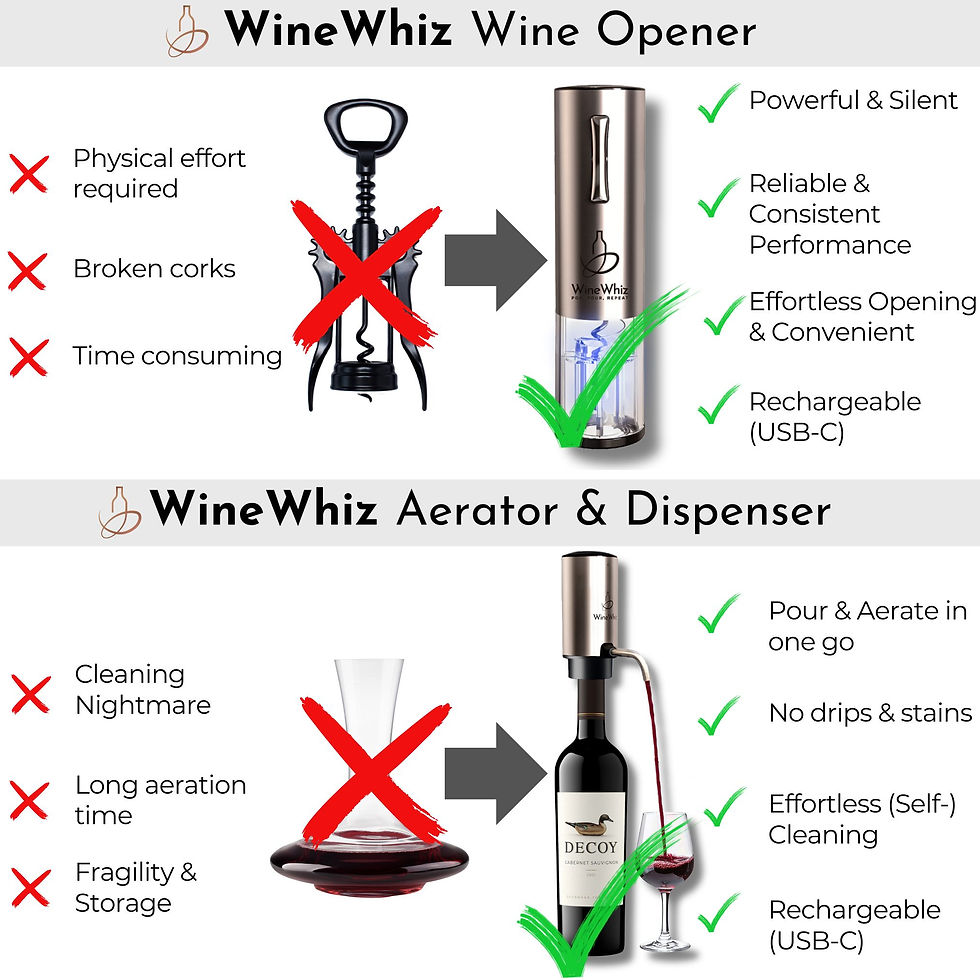
Where a manual corkscrew genuinely wins
Let's start here, because it's the part most brands skip.
It costs a fraction as much. A well-made waiter's friend runs $12–$30 and will outlive any electronic device in your kitchen. If budget is the deciding factor, this is the honest recommendation.
It never runs out of charge. No battery, no cable, no "it stopped halfway through the cork." It works at a campsite, on a boat, and in a power cut.
It's better on old, fragile corks. Corks in wine past roughly fifteen years old can be soft or crumbling, and they want to be eased out slowly by hand - ideally with a two-pronged "Ah-So" opener rather than a screw at all. A motor gives you no feedback. If you're opening something with age on it, do it by hand.
It packs flat and travels. No charging brick, no bulk, and nobody at airport security has ever raised an eyebrow at a corkscrew in a checked bag.
Professionals use them. Sommeliers carry waiter's friends, not electric openers. That's partly ritual and partly control - but it's true, and worth knowing.
Where an electric opener wins
Effort. Two buttons. No leverage, no bracing the bottle between your knees, no technique to learn or explain to a guest.
Consistency. A corkscrew's success depends on how well you centre it and how straight you drive it. A motorised spiral does the same thing every time.
Broken corks. Most broken corks come from an off-centre screw or an impatient pull. The opener self-centres over the neck, which removes the most common cause.
Accessibility. This is the one that matters most and gets mentioned least. Arthritis, tendonitis, reduced grip strength, a healing wrist - a corkscrew becomes genuinely difficult, and a one-button opener restores something people had quietly given up on.
Speed. Roughly six seconds, start to finish. Trivial for one bottle; noticeable when you're hosting eight people.
Decanter vs electric aerator
A decanter and an aerator do the same chemistry: expose wine to oxygen so tannins soften and aromatics open up. They differ in how long and how much washing up.
Where a decanter genuinely wins: it handles a full bottle at once, it lets you pour a mature wine off its sediment - which an aerator cannot do - and it looks beautiful on a table. For a special bottle with an hour to spare, a decanter is still the better object.
Where an aerator wins: it works in the two seconds the wine spends travelling from bottle to glass, so there's no planning ahead. It rinses under a tap instead of requiring a drying stand and a bottle brush. It stores in a drawer instead of occupying a shelf, and it won't shatter. And it aerates by the glass, so you can open a bottle, aerate one glass, and leave the rest of the bottle untouched.
When to use neither: older reds past about fifteen years, delicate whites, and anything sparkling. Air flattens fragile aromatics within minutes, and in sparkling wine it simply costs you the bubbles.
Part 2 - WineWhiz vs other electric wine openers

Here's the thing the category doesn't advertise: the core hardware across most electric wine openers is more similar than the marketing suggests. A motor, a coiled spiral, a rechargeable cell. Anyone claiming a revolutionary cork-extraction mechanism is overselling it.
So the honest comparison isn't about the motor. It's about four things that actually differ.
1. How it charges
Plenty of openers in this category still run on disposable AA batteries, or charge over micro-USB, or use a proprietary base you'll be unable to replace in three years.
WineWhiz charges over USB-C - the same cable as your phone and laptop. It sounds minor until the cable goes missing.
2. What's actually in the box
Most electric openers stop at the cork. Our Set with the Premium Box includes an electric aerator and dispenser, a foil cutter and a vacuum stopper - so opening, serving and preserving are one purchase rather than three.
If all you want is the cork out, you don't need any of that. The Electric Set with Base has the same opener plus a base that keeps it upright and ready on the counter - no drawer, no hunting for a cable. It's a good-looking object in its own right, and it's the one to buy if aeration doesn't interest you.
The Premium Set earns its place if you want the wine to taste better, not just get opened. That's the aerator's job, and it's the only real reason to spend more.
3. What happens when it breaks
This is the real differentiator, and it's not a feature - it's a quick message to WineWhiz.
Read the one-star reviews across this entire category and the same complaints repeat: it stopped working, it won't hold a charge, nobody answered my email. Reliability concerns dominate negative reviews of electric wine openers, and support is where most low-cost sellers disappear.
WineWhiz is a US business. There's US-based support and replacements, and a real person reads the email. We'd rather fix a problem than lose you over it.
4. Drips and cleaning
This sounds trivial right up until it happens on someone's tablecloth.
The common failure in this category is an aerator that doesn't stop when you do. You release the button, the pour ends - and then it keeps dribbling. Read the reviews of competing electric aerators and the same complaint recurs: drips from the spout after the pour has ended, onto the counter, onto the table, onto whatever the bottle happens to be standing near. It's one of the most repeated gripes about the category, and it's a large part of why these devices end up in a drawer.
Ours stops when you stop. The pour cuts off cleanly at the spout, so there's nothing left to fall - no drips between glasses, no coaster needed under the bottle, no wiping down the counter after a dinner party.
Cleaning follows the same logic. The aerator rinses under a warm tap - no disassembly, no small parts to lose, no bottle brush. Anything you have to take apart after every use is something you eventually stop using.
Small things, both. But they're what decides whether a gadget lives on the counter or migrates to the back of a drawer.
Specifications
-
Time to remove a cork: ~6 seconds
-
Bottles per full charge: 80+
-
Charging: USB-C, ~3 hours to full
-
Housing: Stainless steel
-
Cork types: Natural and synthetic
-
In the set: Opener, electric aerator & dispenser, foil cutter, vacuum stopper, USB-C cable
-
Dishwasher safe: No - wipe the housing, rinse the aerator spout
-
Warranty: Amazon returns policy, plus 12 month after purchase
Who should not buy this
-
You open wine two or three times a year. Buy a good waiter's friend and spend the difference on wine.
-
You collect older vintages. Fragile corks want hands, not motors - and you'll want to decant off sediment anyway.
-
You mostly drink white or sparkling. The opener still helps; the aerator won't do much for you.
-
You want one object, not a set. A standalone opener is the cheaper, more sensible buy.
-
You're buying for someone who loves the ritual. Some people enjoy the corkscrew. Don't take that away from them.
The short version
If you open wine occasionally and enjoy the ritual, buy a good manual corkscrew - genuinely. If you open wine often, entertain, have any grip trouble, or you're buying a gift for someone who does, an electric set removes the friction and makes an ordinary bottle taste better on the way to the glass.